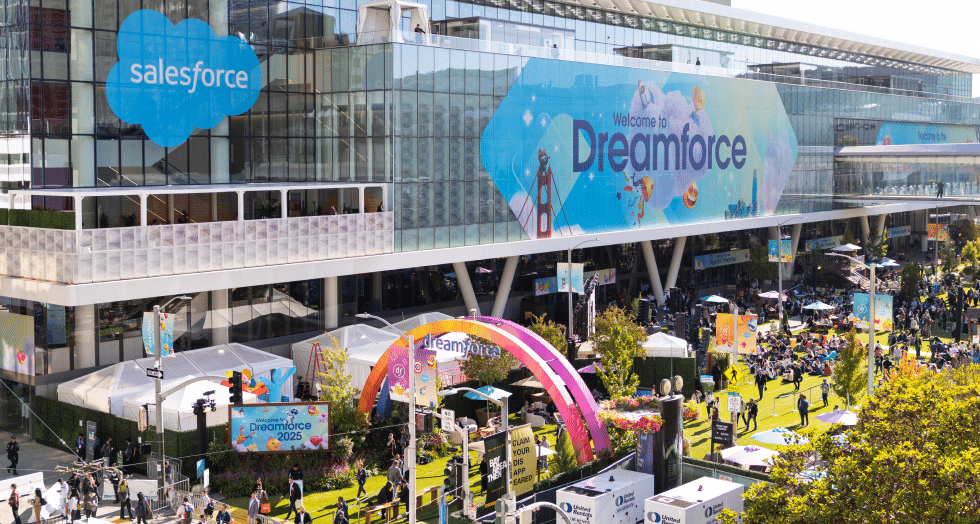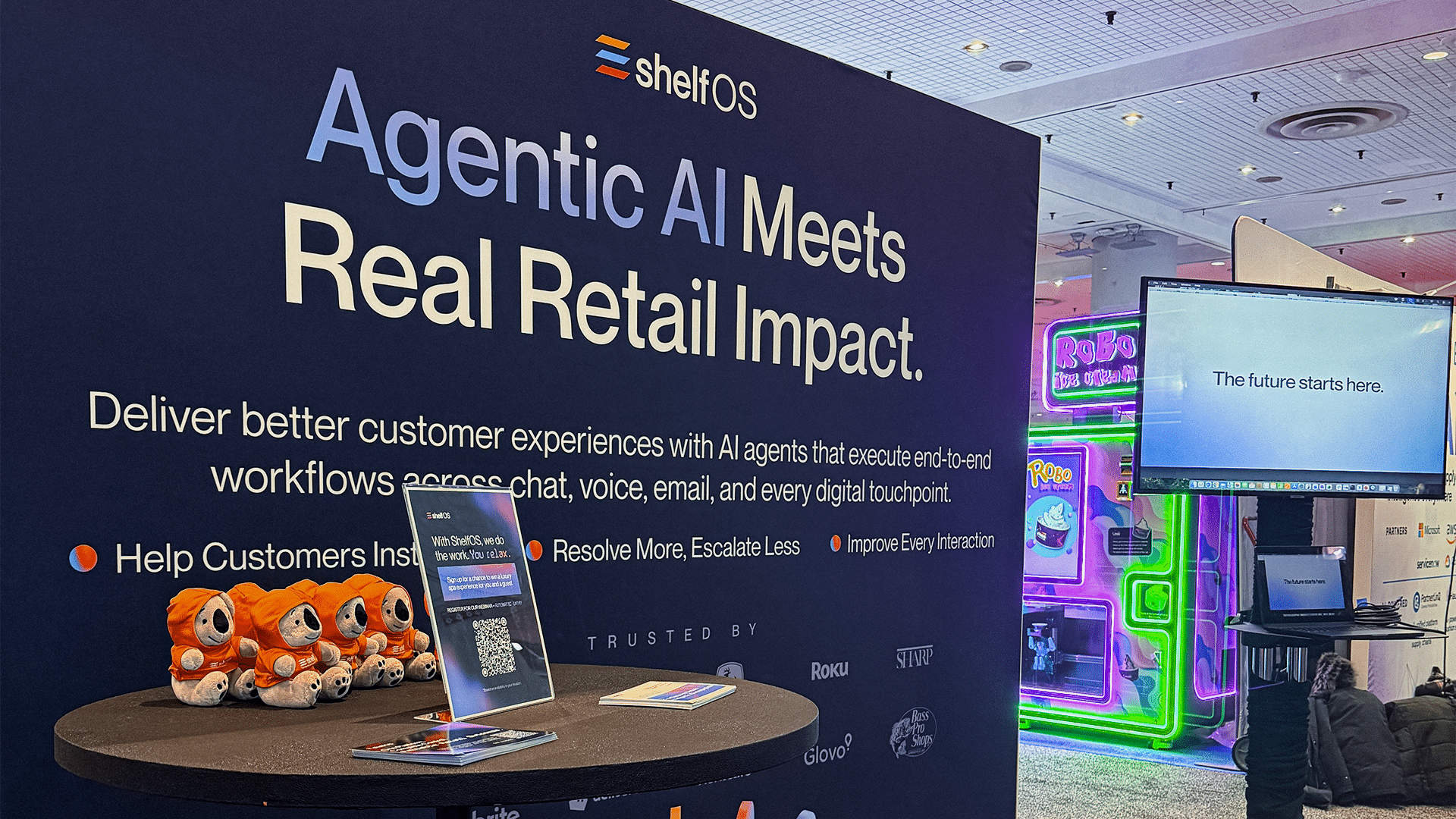
We’re still buzzing from last week’s NRF event. Over three days, our team connected with nearly 500 retailers and industry leaders and the energy around what’s possible with AI was palpable. But beyond the excitement, what struck us most were the candid, unfiltered conversations about where retailers actually are in their AI journey, and the gap between experimentation and execution.
The Reality Check: Most Retailers Are Still at Square One
Here’s what we weren’t expecting: the vast majority of retailers we spoke with are far earlier in their AI adoption than the industry narrative suggests. Many are still grappling with fragmented chatbots that don’t resolve issues, or they haven’t implemented AI at all.
The challenges we heard were strikingly consistent across brands:
- Customer service teams overwhelmed by volume and repetitive questions, leading to burnout and high turnover
- Buyers spending too much time on manual order processing when they should be forecasting demand
- Supply chain leaders lacking visibility into inventory levels and demand signals
- Systems that don’t talk to each other, forcing teams to re-enter data and chase down information across email and spreadsheets.
One retailer told us their chatbot escalates 90% of conversations to humans. Another described their abandoned cart rate spiking after customers interacted with their bot. These aren’t edge cases, they’re the norm.
At Shelf, we work with organizations to address exactly these friction points: giving agents and back-office teams instant access to accurate answers and automated workflows so they can resolve issues faster, reduce handle time, and free people from the mundane tasks that drain productivity and morale. That’s what led us to build Shelf Agent OS, a platform purpose-built for retail that enables the creation, execution, coordination, management, and optimization of AI agents across the entire operation, not just one isolated touchpoint.
Beyond the Chatbot: Where the Real Interest Lives
While customer-facing chatbots were a common starting point in conversations, interest quickly expanded into territory that matters more to operations leaders: back-office automation, inventory management, staffing optimization, and disconnected tech stacks.
One conversation stood out in particular. We spoke with at least four retailers who described the same challenge around merchandising: deciding which products belong in which locations based on local demand patterns, product correlations, and statistical modeling. This isn’t a one-off problem. It’s a repeatable pain point that echoes across grocery, apparel, and convenience retail. It’s the kind of use case that doesn’t make headlines but directly impacts margin and customer satisfaction.
From grocery chains exploring AI for staffing schedules and preventing out-of-stock scenarios, to luxury brands looking to automate quality management workflows, the appetite for operational AI is significant and largely underserved.
What We Heard From the Main Stage
The speaking sessions reinforced what we were hearing on the floor. Across panels featuring CTOs from Bealls, Kroger, Home Depot, Tapestry, and others, several themes surfaced again and again:
Change management is harder than the technology. Multiple executives emphasized that legacy systems, messy data, and internal resistance are bigger obstacles than the AI itself. Data quality isn’t a nice-to-have, it’s foundational.
Agentic AI is about end-to-end execution, not better chatbots. The shift is from assistive tools to autonomous actors that can complete workflows without constant human intervention.
Associate experience drives customer experience. Home Depot, Kroger, and Tapestry all emphasized the same principle: your customer experience will never exceed your associate experience. AI should remove repetitive, menial tasks so frontline employees can focus on empathy, creativity, and connection.
Human-in-the-loop. Trust and governance were recurring concerns. Retailers are willing to adopt AI, but they need guardrails, transparency, and the ability to intervene when logic breaks down.
The message was clear: this is not a technology conversation anymore. It’s an operating model conversation.
What This Means for the Future
If NRF 2026 made anything clear, it’s that we’re at an inflection point. Retailers are moving from AI experiments to production. The pilots are over. Now the question is: who can deliver outcomes?
The winners in this space won’t be the ones with the flashiest demos. They’ll be the ones who can:
- Meet retailers where they are, not where the hype cycle says they should be
- Solve for operations as much as customer experience
- Build systems that work with existing infrastructure, not against it
- Prove ROI quickly and scale intelligently
We left NRF with a clearer picture of what retailers actually need and a strong sense that the industry is ready to move from conversation to action. The path forward isn’t about doing everything at once. It’s about identifying the single most important use case, proving value, and building from there.
We’re already following up with dozens of teams who are ready to take that next step. If the conversations we had are any indication, 2026 is going to be the year AI in retail gets real.
Want to continue the conversation? Schedule a call with an expert.